THE FIRE WITHIN
When Persistent Inflammation Can Damage DNA and Favor the Development of Cancer
Imagine that a small part of your body becomes injured. Within minutes, the immune system receives an alarm signal. Blood vessels change, blood flow increases to the affected area, and different immune cells arrive to defend, clean up, and begin the repair process.
That is inflammation, and we need it.
Inflammation is not a disease. It is one of the body’s most important defense mechanisms. Without it, our bodies would have great difficulty fighting infections, removing damaged cells, and repairing wounds.
But there is an important difference between inflammation that does its job and then turns off, and inflammation that remains silently active for months or even years.
CHRONIC LOW-GRADE INFLAMMATION
Unlike the obvious inflammation we see with an injury, chronic low-grade inflammation may not cause intense pain, fever, or visible swelling. It can continue for years without a person ever feeling that something is “inflamed.”
Yet inside the body, subtle alarm signals may remain active, inflammatory mediators may stay elevated, and tissues may remain caught in repeated cycles of damage and repair. The problem is not necessarily that the inflammation is intense. The problem is that it never completely turns off.
This connection is well established. The National Cancer Institute (NCI) explains that chronic inflammation can persist even when there is no obvious injury or after the original trigger should have resolved. Over time, this persistent inflammation can cause DNA damage and contribute to cancer development. The NCI points to chronic inflammatory bowel diseases such as ulcerative colitis and Crohn’s disease as examples of conditions associated with an increased risk of colon cancer.
When tissues remain in an inflammatory state for long periods of time, there are more opportunities for cellular alterations to occur. And one of the structures that can eventually be affected is our DNA.
HOW DOES INFLAMMATION BECOME CHRONIC?
Our immune system is designed to activate when it detects danger and then gradually return to balance. But what happens when small danger signals continue appearing again and again?
Excess visceral fat, smoking, persistent infections, certain inflammatory conditions, metabolic dysfunction, physical inactivity, chronic sleep disruption, and repeated exposure to damaging substances can all contribute to persistent inflammatory signaling. This does not mean that any one of these factors automatically causes cancer. The process is far more complex.
When the body repeatedly receives signals of damage or stress, however, certain immune cells may remain partially activated. These cells release chemical messengers called cytokines, including IL-6, TNF-α, and IL-1β.
Under normal circumstances, these substances are helpful. They are essentially telling the body: “There is a problem. We need to defend and repair.”
But when that message continues for months or years, tissues can become trapped in a prolonged state of alert.
The normal cycle should look like this:
Damage → inflammation → repair → resolution
But chronic inflammation can turn it into:
Damage → inflammation → incomplete repair → new damage → more inflammation
And this is where an important connection with cancer begins.
INFLAMMATION AND OXIDATIVE STRESS
When immune cells become activated, they produce highly reactive molecules, including reactive oxygen and nitrogen species. These molecules are not inherently harmful; our immune system actually uses them to help destroy microorganisms and respond to damaged tissue.
The problem develops when these reactive molecules are produced repeatedly and begin to exceed the body’s ability to neutralize them and repair the damage they create.
This imbalance is known as:
OXIDATIVE STRESS
These reactive molecules can interact with different structures inside the cell, including:
cell membranes
proteins
mitochondria
chromosomes
DNA
A scientific review examining the chemistry of chronic inflammation found that reactive oxygen and nitrogen species released by activated immune cells can damage nucleic acids directly and indirectly. At sufficiently high and persistent levels, this damage can result in mutations and contribute to the carcinogenic process.
Another review specifically examining inflammation-induced DNA damage, mutations, and cancer describes this as an important biological bridge between inflammation and cancer: reactive molecules created during inflammation can damage DNA, and that damage can promote mutations involved in cancer initiation and progression.
Why does that matter so much? Because DNA contains the instructions that tell a cell when to grow, when to divide, when to stop, when to repair damage, and when to die if it can no longer function safely.
DNA is extraordinarily well protected, but it is not invulnerable.
OUR DNA IS DAMAGED EVERY DAY
It may sound surprising, but our cells experience small amounts of DNA damage every day. This can happen through normal metabolism, errors made when DNA is copied, or outside influences such as ultraviolet radiation, tobacco smoke, and certain chemicals.
Most of this damage never becomes cancer. Why? Because our cells contain sophisticated systems for detecting and repairing damaged DNA.
When a cell identifies a problem, it can:
repair the DNA correctly
temporarily stop dividing while repairs are made
eliminate itself if the damage is too severe
These protective systems are working constantly without us ever noticing. But they are not perfect.
During persistent inflammation, tissues may experience repeated exposure to reactive molecules while simultaneously trying to repair themselves. This creates a situation involving more cellular damage, more repair, and more cell division. And every additional round of damage and repair creates another opportunity for an error to occasionally remain.
WHEN THE ERROR BECOMES PERMANENT
If DNA damage is repaired incorrectly and the change remains permanently written into the genetic sequence, we call that a mutation. A mutation does not automatically mean cancer; in fact, we all accumulate mutations throughout life, and many of them have no meaningful effect.
The situation changes when a mutation affects a gene that controls how a cell behaves. Inside our cells are several groups of genes that can be compared to the control systems of a car: some work like the accelerator, others act like the brakes, and still others function like the mechanics, repairing damage when something goes wrong.
ACCELERATORS, BRAKES, AND MECHANICS
Genes that promote growth and cell division are necessary. When we need to replace an intestinal cell, repair a wound, or produce new blood cells, these genes help activate growth.
But if one becomes altered in a way that keeps it excessively active, it may continue sending growth signals when they are no longer needed. Certain altered growth-promoting genes are known as oncogenes.
Then we have tumor suppressor genes, which function like the brakes. They help stop cell division when something is wrong and can give the cell time to repair damage. Their message is essentially: “Stop. Do not divide yet. There is damage that needs to be repaired first.”
If these control mechanisms are lost, a damaged cell may continue dividing when it should have stopped.
Finally, there are genes responsible for DNA repair. Think of these as the cellular mechanics. When repair systems themselves become defective, additional genetic errors can accumulate more easily.
A cell that gradually loses its brakes, keeps its accelerator pressed, and becomes less efficient at repairing its DNA enters a very different biological situation.
ONE MUTATION IS USUALLY NOT ENOUGH
This is one of the most important concepts to understand: a normal cell usually does not become cancerous because of a single mutation.
Cancer more often develops after the progressive accumulation of multiple genetic and epigenetic alterations. It may begin with one mutation while the cell continues living. Later, another change may allow it to divide more easily, another may weaken one of its braking systems, and another may help it resist programmed cell death.
Additional changes can allow certain cells to interact differently with their environment or evade some of the body’s normal defenses. This process can take many years — sometimes even decades.
FROM ONE ALTERED CELL TO A POPULATION
Imagine that one cell develops a mutation that gives it a small survival or growth advantage. It divides, and its daughter cells inherit that same change. Now there is a small population of altered cells.
Within that population, another genetic change may appear. One cell gains an additional advantage and begins multiplying more successfully. Later another alteration may arise.
Over time, cells that are better able to survive and reproduce can begin to dominate the population. This process is known as clonal evolution.
It helps explain why cancer is not simply a normal cell that suddenly “turned bad.” It is often a progressive process of cellular change, selection, and accumulation.
WHAT ROLE DOES INFLAMMATION PLAY?
This is where the connection becomes especially important. Chronic inflammation can influence several parts of this process at the same time.
1. It can increase DNA damage
Reactive oxygen and nitrogen species produced during inflammation can damage components of genetic material. This mechanism has been extensively investigated as one of the connections between persistent inflammation and cancer.
2. It can increase the need for tissue repair
When tissue is repeatedly injured, cells must regenerate more often. That means additional cell divisions and additional copying of DNA.
3. It can create a growth-promoting environment
During normal repair, tissues release cytokines and growth signals intended to help restore damaged areas. Persistently altered cells may also respond to some of these signals.
4. It can change the tissue microenvironment
Immune cells, blood vessels, connective tissue, and altered cells can begin interacting in increasingly complex ways. This is why the relationship between inflammation and cancer is not only about direct DNA damage. It is also about the biological environment surrounding the cells.
THE CIRCLE OF INFLAMMATION, DAMAGE, AND MUTATION
Persistent inflammation can create a chain in which inflammatory and reactive molecules contribute to oxidative stress, DNA undergoes repeated damage, repair becomes necessary again and again, and occasional errors can become permanent mutations.
If enough relevant alterations accumulate in genes involved in growth, DNA repair, and cell death, certain abnormal cells may gain advantages that allow them to survive and multiply. Additional alterations can then accumulate over time.
Persistent inflammation → oxidative stress → DNA damage → repair → occasional mutation → accumulation of cellular alterations → possible tumor development
This process is not inevitable, and it does not happen in exactly the same way in every person. But it helps explain why the NCI recognizes chronic inflammation as one biological process capable of producing DNA damage and contributing to cancer.
CANCER CAN ALSO FUEL INFLAMMATION
Another fascinating aspect of this relationship is that it can work in both directions. Chronic inflammation can contribute to cellular damage, but once tumor cells develop, they may also release signals that recruit immune and supporting cells and modify the surrounding tissue.
Another cycle can then form:
Inflammation → cellular damage → genetic alterations → abnormal cells → more inflammatory signaling
This is why scientists no longer view a tumor simply as a collection of cancer cells. It exists within a tumor microenvironment containing immune cells, blood vessels, fibroblasts, inflammatory molecules, and other components of the surrounding tissue.
Cancer cells continuously interact with this environment.
INFLAMMATION DOES NOT MEAN CANCER
This distinction is essential. Inflammation is necessary for life, and a person can experience inflammation many times without ever developing cancer. Likewise, someone may develop cancer even when chronic inflammation was not the major factor involved.
Cancer is a complex, multifactorial disease. Mutations may arise from many sources, including:
natural errors during DNA replication
aging
tobacco exposure
ultraviolet radiation
certain carcinogenic substances
some infections
inherited genetic mutations
accumulated cellular damage
It would therefore be incorrect to say that chronic inflammation causes all cancer. But it would also be incorrect to ignore its role.
Persistent inflammation can contribute to DNA damage while also changing the environment in which altered cells live and grow.
WHY DOES THIS MATTER?
A tumor that becomes detectable today may represent the visible stage of a biological process that began many years earlier. The first cellular alteration may have occurred long ago, followed gradually by additional changes. Eventually, a small population of cells may acquire enough alterations to begin behaving abnormally.
This changes how we think about prevention.
We cannot prevent every mutation. We cannot completely control aging or all of our inherited risk. But we can work on some of the conditions associated with persistent inflammation and cellular damage.
Prevention is not about guaranteeing that cancer will never occur. It is about reducing modifiable risks and reducing opportunities for damage to accumulate.
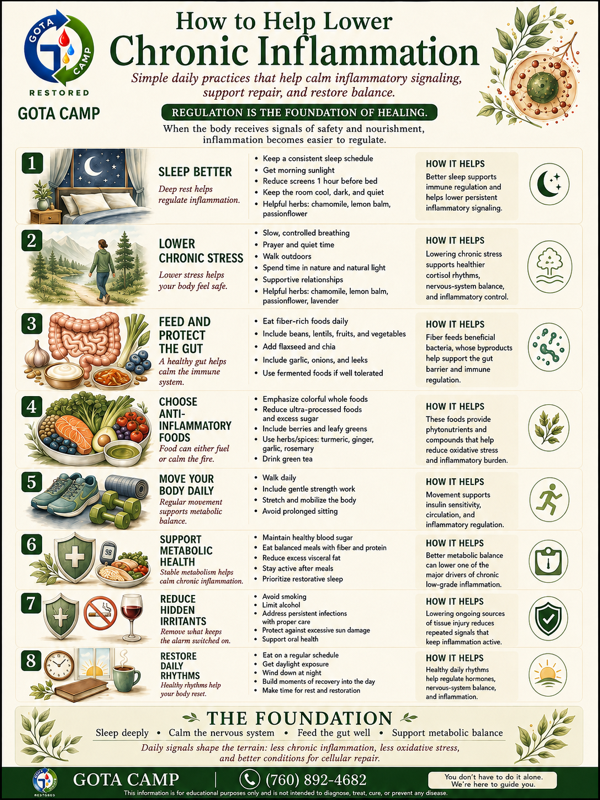
HOW CAN WE HELP THE BODY LOWER INFLAMMATION?
The goal is not to eliminate inflammation. We need inflammation. The goal is to help the body resolve the inflammatory response once the threat has passed, rather than remaining in a constant state of biological alert.
Three areas deserve special attention.
1. SLEEP BETTER
Sleep does much more than restore energy. It also interacts directly with the immune system and helps regulate inflammatory signaling.
One large systematic review and meta-analysis examined 72 studies involving more than 50,000 participants. Sleep disturbance was associated with higher levels of C-reactive protein (CRP) and IL-6, two commonly studied markers of systemic inflammation. In other words, repeatedly disrupted sleep can be part of an inflammatory environment.
To support better sleep:
Keep a consistent bedtime and wake time.
Get natural light in the morning.
Reduce bright light and screens before bedtime.
Keep the bedroom cool, dark, and quiet.
Gentle herbal teas such as chamomile, lemon balm, or passionflower may support relaxation in some people.
Better sleep → better immune regulation → fewer persistent inflammatory signals.
2. LOWER CHRONIC STRESS
Occasional stress is normal and can even be useful. The problem develops when the brain and body spend weeks or months receiving the message that danger is always present.
Cortisol normally participates in controlling excessive inflammation. However, research suggests that chronic psychological stress can alter glucocorticoid receptor signaling, making immune cells less responsive to some of cortisol’s regulatory effects.
A systematic review examining animal, primate, and human research found that chronic stress was consistently associated with changes in glucocorticoid signaling and increases in pro-inflammatory biomarkers.
This means that managing chronic stress is not simply about “feeling calmer.” It can affect communication between the brain, stress hormones, nervous system, and immune system.
Helpful practices may include:
slow, controlled breathing
prayer and daily periods of quiet
walking outdoors
time in nature and natural light
regular physical activity
meaningful and supportive relationships
Gentle herbs traditionally used to support relaxation include chamomile, lemon balm, passionflower, and lavender.
Less chronic stress → healthier stress-response regulation → better control of inflammatory signaling.
3. FEED AND PROTECT THE GUT
The gut and immune system are closely connected, and what we eat helps determine what many intestinal bacteria are able to produce.
When beneficial gut microbes ferment certain dietary fibers, they produce compounds known as short-chain fatty acids, including acetate, propionate, and butyrate.
These compounds do much more than feed bacteria. Research shows that short-chain fatty acids participate in immune regulation and help maintain the intestinal epithelial barrier. Butyrate, in particular, is an important energy source for colon cells and has been associated with mechanisms that support tight-junction proteins and intestinal barrier integrity.
That gives us another important connection: what we feed our gut microbes can influence the signals they send back to us.
Foods that help provide fiber and substrates for a diverse microbiome include:
leafy greens and colorful vegetables
broccoli, cabbage, cauliflower, and other cruciferous vegetables
whole fruits and berries
beans, lentils, and other legumes
flaxseed and chia seeds
nuts and seeds
garlic, onions, and leeks
fermented foods when appropriate and well tolerated
Foods and herbs such as turmeric, ginger, garlic, rosemary, and green tea also contain compounds that have been studied for anti-inflammatory activity.
A healthy intestinal barrier helps separate intestinal contents from the internal circulation while allowing appropriate nutrients to pass through. Supporting that barrier and the microbes that live alongside it can contribute to healthier immune regulation.
Healthier gut → stronger intestinal barrier → better immune regulation → lower inflammatory burden.
IT IS NOT ABOUT ONE HERB OR SUPPLEMENT
There is no single herb, supplement, or food that can “switch off” chronic inflammation by itself. Herbs and supplements may be useful tools, but they cannot continually compensate for disrupted sleep, chronic stress, smoking, poor metabolic health, or a diet that does not adequately support the gut.
The foundation remains remarkably simple:
Sleep deeply.
Calm the nervous system.
Feed the gut well.
These daily signals can help create an internal environment with better inflammatory regulation and healthier conditions for normal cellular repair.
A SMALL FLAME THAT NEVER GOES OUT
Inflammation began as our ally. Its purpose is to defend, clean, repair, and then return the body to balance.
The problem begins when that response remains silently active for years. A tissue that continually cycles between injury and repair has more opportunities for damage and cellular errors to occur.
Most DNA damage will be repaired. Many severely damaged cells will be eliminated. But occasionally, one alteration may remain. Then another. And another.
Eventually, certain cells may progressively lose some of the systems that once controlled their growth.
Chronic low-grade inflammation does not mean cancer. But evidence shows that persistent inflammation can contribute to DNA damage and create a biological environment in which mutations and abnormal cellular selection have more opportunities to occur.
And perhaps this is one of the most important ideas to remember:
The cancer we detect today may represent a biological process that began years before the tumor became detectable.
Taking care of our health is not only about reacting once disease appears. It is also about reducing, day after day, modifiable conditions that favor persistent inflammation and cellular damage.
Because protecting the terrain today may influence what happens inside our cells tomorrow.
This material is for educational purposes only and is not a substitute for individualized medical evaluation, diagnosis, prevention, or treatment. Herbs and supplements may interact with medications or may not be appropriate for certain health conditions.
STUDIES & SOURCES
National Cancer Institute — Chronic Inflammation. Explains how chronic inflammation can cause DNA damage over time and contribute to the development of certain cancers. https://www.cancer.gov/about-cancer/causes-prevention/risk/chronic-inflammation
Kay J, Thadhani E, Samson L, Engelward B. — Inflammation-Induced DNA Damage, Mutations and Cancer. Reviews how inflammation-related reactive oxygen and nitrogen species can damage DNA, promote mutations, and contribute to cancer development and progression. https://pmc.ncbi.nlm.nih.gov/articles/PMC6801086/
Dedon PC, Tannenbaum SR. — Reactive Species and DNA Damage in Chronic Inflammation. Explains how reactive molecules produced during chronic inflammation can damage nucleic acids and contribute to permanent genetic changes. https://pmc.ncbi.nlm.nih.gov/articles/PMC3334345/
Irwin MR, Olmstead R, Carroll JE. — Sleep Disturbance, Sleep Duration, and Inflammation: A Systematic Review and Meta-Analysis
A review of 72 studies involving more than 50,000 participants examining the relationship between sleep disruption and inflammatory markers such as CRP and IL-6.
Chronic Stress and Glucocorticoid Signaling — Systematic Review
Reviews evidence showing that chronic psychological stress can alter glucocorticoid signaling and is associated with increased pro-inflammatory biomarkers.
Short-Chain Fatty Acids, Gut Barrier, and Immune Regulation
Reviews how gut-microbiota-derived short-chain fatty acids, including butyrate, help support intestinal barrier integrity and immune regulation.https://pmc.ncbi.nlm.nih.gov/articles/PMC10049789/