MYCOTOXINS
The Invisible Burden on Human Healtht
How mold-derived toxins enter the body, disrupt key systems, and what you can do to reduce your daily exposure.
There are toxins we consciously try to avoid—pesticides, heavy metals, plastics. And then there are the ones we don’t even realize we’re exposed to… every single day.
They don’t have a smell. They don’t announce themselves. And yet, over time, they may quietly add to the body’s internal burden—affecting digestion, immunity, energy, and even how clearly we think.
These are mycotoxins.
What are mycotoxins ... really?
Mycotoxins are toxic compounds produced by certain molds—microscopic fungi that grow on food, in damp environments, and sometimes in the air we breathe. They are not the mold itself. They are the chemicals produced by mold. And many of them are surprisingly resilient.
Studies show that several mycotoxins can remain stable even after food processing or heating, which means exposure is not always obvious or avoidable through cooking alone¹. So the issue is often not a single exposure. It’s repeated, low-level exposure over time the kind that quietly adds up.
Where does exposure come from?
Not just obviously moldy food. More often, it’s subtle.
Certain foods are more vulnerable due to how they are grown, harvested, and stored, especially those kept in bulk or exposed to humidity.
Among the most commonly affected:
Wheat
Corn
Rice
Peanuts
Pistachios
Tree nuts and seeds
Coffee and cacao
Dried fruits and spices
Corn and peanuts, in particular, are well known for their susceptibility to aflatoxin contamination, one of the most studied mycotoxins, especially for its effects on the liver².
This does not mean these foods are inherently harmful. But it does mean they can become carriers of unwanted compounds depending on storage conditions, moisture exposure, and quality control.
A simple but important question
Instead of asking, “Are these foods healthy or unhealthy?” A more helpful question might be: What is the total exposure load that comes with them?
Because for some individuals, especially those dealing with chronic symptoms, gut dysfunction, or toxic burden-reducing exposure, even temporarily, may create noticeable relief.
What happens inside the body?
To understand the impact of mycotoxins, it helps to see the body as a connected system rather than isolated organs.
Because these compounds don’t stay in one place: They move. They interact. And they influence multiple systems along the way.
For most people, exposure begins in the gut. This is where mycotoxins first encounter the intestinal lining—the body’s primary barrier between the outside world and internal circulation. Research suggests that certain mycotoxins can disrupt this barrier by affecting tight junctions and intestinal integrity³.
When this happens, the gut becomes more permeable, allowing not only mycotoxins but other inflammatory compounds to pass through more easily.
From there, these compounds are transported to the liver, one of the body’s main detoxification organs. The liver works continuously to transform and eliminate toxins. However, many mycotoxins are fat-soluble, meaning they rely on bile to be excreted.
And this is where a key issue can arise. If bile flow is not optimal, these compounds may not be efficiently eliminated. Instead, they are released into the intestine and can be reabsorbed back into circulation—a process known as enterohepatic recirculation⁴.
In simple terms: the body processes them… but then encounters them again.
At the same time, the immune system is constantly responding to what enters circulation. Mycotoxins have been shown to alter immune function sometimes suppressing immune defenses, and other times overstimulating inflammatory pathways⁵. Over time, this can contribute to a system that feels dysregulated—either more reactive or less resilient.
And the effects don’t stop there. Some mycotoxins have been studied for their ability to increase oxidative stress and inflammation, including in nervous system tissues⁶.
This helps explain why, in certain individuals, exposure may be associated with symptoms that extend beyond digestion—such as fatigue, difficulty concentrating, mood changes, or brain fog.
So rather than thinking in isolated systems, it may be more accurate to think of mycotoxins as creating a ripple effect: They begin in the gut, are processed through the liver, circulate through the immune system, and influence how the body feels as a whole.
Why can they accumulate?
Not because the body is failing—but because the conditions around exposure and elimination matter. The body is constantly working to eliminate toxins.
But when:
Exposure is ongoing
Gut integrity is compromised
Bile flow is sluggish
Or detox pathways are overloaded
…then elimination may not keep up with intake.
Some mycotoxins, such as ochratoxin A, have even been shown to persist in the body due to recirculation and tissue binding⁴.
So over time, a simple imbalance can occur: The body may be taking in more than it can efficiently eliminate.
Why this matters more than we think
Mycotoxins rarely cause one single, obvious disease. Instead, they contribute to a background burden. Subtle—but persistent.
People may experience:
Fatigue
Digestive issues
Skin conditions
Hormonal imbalance
Brain fog
Histamine sensitivity
Even more serious conditions like Hepatocellular carcinoma and Kidney Damage…without ever connecting it back to environmental or food-based exposure.
Where does someone begin?
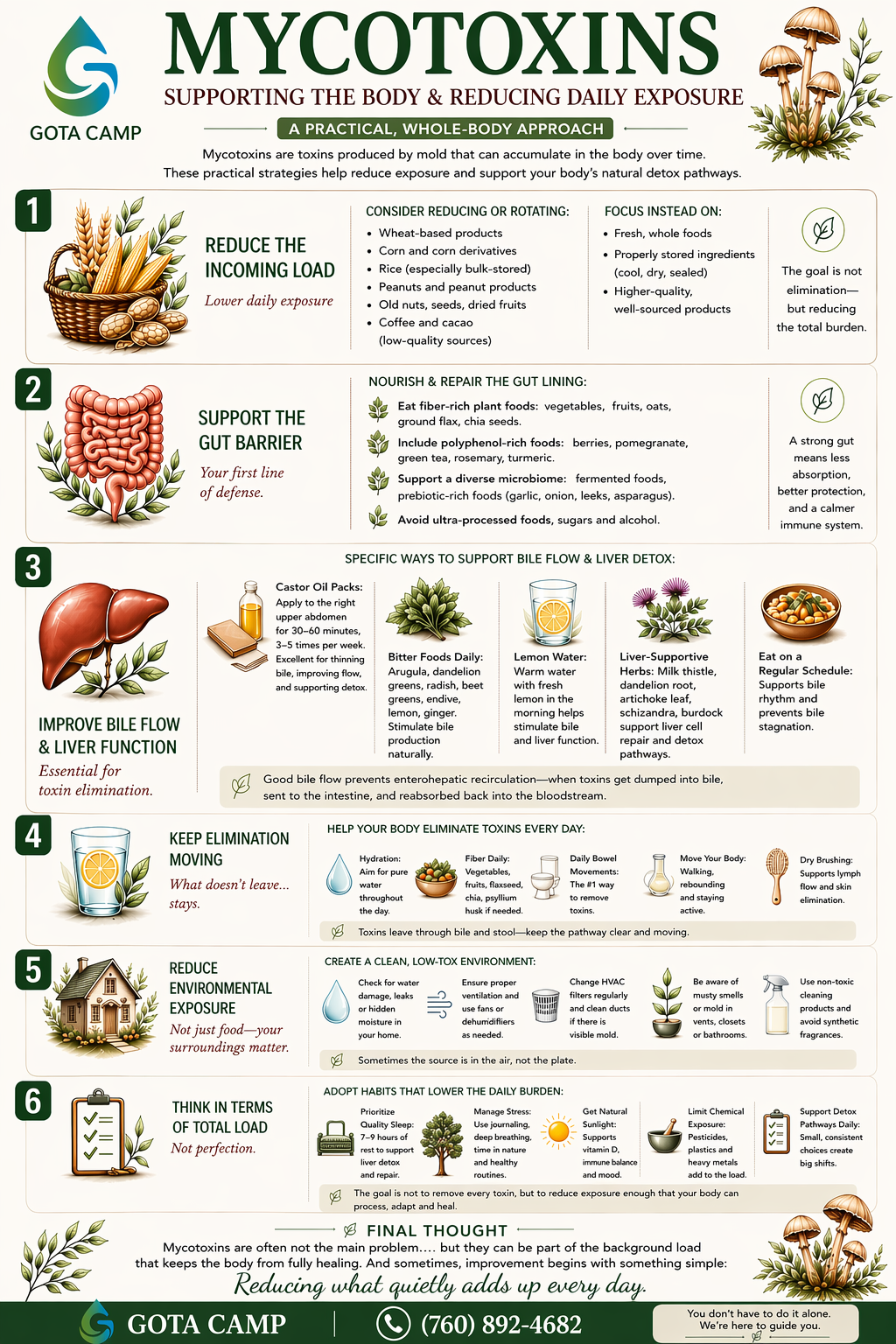
With awareness—and small, strategic changes. Reduce high-risk exposure (temporarily)
For some individuals, it may be helpful to reduce foods most commonly associated with contamination:
Wheat
Corn
Rice
Peanuts
Pistachios
This is not necessarily permanent. It’s a way to lower the incoming burden while the body restores balance.
1. Support the gut — Because the gut is the first line of defense, supporting its integrity matters. Focusing on:
Whole, fresh foods
Fiber-rich plant diversity
Minimizing heavily processed and long-stored foods
… can help strengthen the barrier and miscrobiome³.
2. Keep elimination moving — Many toxins leave the body through bile and stool. So hydration, regular digestion, and bowel movements are essential—not as an extreme intervention, but as basic physiology.
Think in terms of load, not perfection. The goal is to reduce the daily burden enough that the body can process, adapt, and recover.
Final thought
Mycotoxins are not always the main problem. But in some cases, they are part of the background load that keeps the body from fully healing. And sometimes, improvement begins with something simple: Reducing what quietly adds up every day.
References
Mahato DK, et al. Toxins (Basel). 2021 • Kirk GD, et al. Carcinogenesis. 2006 • Gao Y, et al. Toxins (Basel). 2020 • Roth A, et al. Toxicology. 1988 • Sun Y, et al. Toxins (Basel). 2023 • Doi K, Uetsuka K. Int J Mol Sci. 2011 • Goessens T, et al. Environ Health. 2024 • Kortei NK, et al. Toxins (Basel). 2021 • Kraft S, et al. Toxins (Basel). 2021